Wednesday, March 4, 2026

Come on, Spring!

February 2026 was the Month of Ice this year, so all of our early bloomers (red maples, hellebores) are running weeks behind. But they're feeling the tingle of spring, which means pollen for building new bee brood!

Sunday, January 25, 2026

Hives in the snow

Winter is hitting hard. It has been snowing and sleeting all day. The bees, however, are tucked in and cozy, clustering in their boxes. It'll be a while before they get to come out to stretch their wings again.

Saturday, January 3, 2026

Plans for 2026


As I enter my fourth year as a beekeeper, I'm looking to step up my game a bit in 2026.


The first step will be expanding my apiary. I started a new yard last year in Crimora, which is about an hour from my house. While the two colonies currently there seem to enjoy the space -- and there are loads of flowering trees and other plants for them -- I have struggled to get my electric fence to work properly. Too many rocks to drive the grounding rod in deep enough, I theorize. 

Also, it's a several-hour adventure to get out to Crimora and back, which means I can't do it as often as I'd like. So I may relocate those colonies to my home property and set up a new yard on another corner of our land where I can add more full-sized hives and maybe develop some nucs for sale in the future.


The second step will be trying a Demaree Split for the first time. I was going to try this maneuver in 2025, but chickened out. It's a bit complicated to set up, but will stop swarming in its tracks and provide a larger amount of honey than a hive can do normally. This fixes with my third step.


The third step is to increase honey production and sales this year. In 2025, the bees produced 135 pounds of honey and four pounds of wax out of three hives, more or less. One of my strongest hives (White) collapsed due to a run-away mite infestation and subsequent hive beetle invasion. I'm hoping to prevent a repeat of that while relying on another three to four colonies for honey. All told, I'm shooting for six or seven honey producing colonies in 2026, with the rest being splits and swarms that will grow into honey producers in 2027.

The fourth step will be to introduce new bee-derived products. I'm going to buy a couple pollen traps to add bee pollen to my market stall along with waxed fabric wraps for food and container coverings. In 2025, I experimented with making beard balms, which I liked but didn't sell, and lip balm, which I used and gave away, and candles. All include beeswax in their recipes.


I also made holiday gift boxes, which I sold quite a few of to my friends but failed to sell at the market. I think there's a chance to try those again this year, although I may have to work on finding the right market for the beard balm -- maybe the Archwood Green Barns market at The Plains. It's a haul, but honey sold well there last year.

But first, we have to make it through winter. So fingers crossed that our existing colonies come out the other side healthy and abundant and ready to harvest. Let's go, 2026!


Thursday, December 18, 2025

Dead-out

One of my hives died recently. 

I don't know exactly when, but I suspect it happened during our recent cold snap when nighttime temperatures dropped to 10 degrees. 

Bees survive the cold by clustering in a tight ball and flexing their wing muscles to generate warmth. This colony was undersized going in to December, so I didn't have a lot of hope for them.
Colonies died over winter. It's something all beekeepers must plan for. Small colonies can be lifeboated by placing them atop another colony separated by a double screenboard to keep the two colonies from mixing pheremones, which could cause one queen to try to kill the other.

I considered lifeboating this one, but its likely partner was fairly small itself and I worried about being able to tend them both if they needed additional resources.
The dead-out solved that problem. The unused resources from the dead hive, including multiple frames of capped honey, went to the White hive, inproving its chances of survival.

Wednesday, December 17, 2025

Waiting for Spring

It's that time of year when the bees hunker down and wait for spring. I'm right there with them.
Until I became a beekeeper, I never really thought about what bees did in the winter. I guess I assumed they died out or went underground.
The fact is that they huddle together like penguins in Antarctica flexing their wing muscles to generate the heat needed to keep the colony alive. These bees can live up to six months and have more body fat that their summer sisters.
The winter crew lives off of the honey stored by the summer workforce, moving upward through the stores as the winter progresses. If all goes well, they will have exhausted their reserves about the time the first blossoms appear in the spring.
To give them a little nutritive cushion, I will add candyboards -- blocks of hard sugar -- to the hives between now and March. That will help the smaller colonies make it all the way to spring, hopefully.

Monday, October 20, 2025

Black Walnuts, Yum

Every fall, the half-dozen or so black walnut trees on our property pepper the yard with their billiard ball-sized progeny. After nearly twisting my ankle stepping on them repeatedly the first year we lived here, I vowed to do something with them to make the trees earn their keep.

I asked for a nut roller for Christmas, and the next year I started collecting black walnuts. The meat of black walnuts is loaded with beneficial compounds, which is benefit number one of black walnuts. 

Black walnuts make you earn those benefits, however. 

First there's the green (or black as it breaks down) outer hull to get through. This is guaranteed to stain your hands and clothing if you're not careful -- so wear gloves and maybe an apron. Definitely do not wear your Sunday best for this job.

I process my walnuts in a trashcan with some water and a paint/cement mixer to churn the nuts against each other to break down the outer part. Any hull-free nuts that float are duds -- minimal meat, mostly air pockets. Get rid of them.

The jet black liquid you get from processing the walnuts can be used to make a dye for natural fabrics. The result is a lovely light brown color. So, that's benefit number two of black walnuts.

After they dry in the sun for a while, I bag them up in a burlap sack so they continue to get air as they cure. In the shell, black walnuts will last for months to years. I'm just now processing the nuts I bagged up two years ago, and they're about 50/50 good vs duds that have gone bad over time. So maybe a smaller interval between harvest and finishing is better....

Before I get cracking, I soak my walnuts in water overnight -- a trick I learned from Feral Foraging on YouTube. I don't follow his entire formula, but the soaking definitely makes cracking these tough nuts considerably easier. Without the bath, they're much more likely to explode like a hand grenade when pressed.

It's tedious, time-consuming work. It's also mindless, which allows me to catch up on a Netflix show or listen to a podcast as I work my way through a mound of nuts. So far, I've produced about three quarts of nut meats, which I packaged for sale at our last farmers market. 

Sadly, I got no takers, but I love black walnuts and I'm sure plenty of other people out there do as well. They just don't know it yet.


Just for good measure, here's a bunch of recipes using black walnuts.

Friday, August 22, 2025

Late swarm


The other morning, Jen woke me with the magic words: "There's a swarm in the apple tree."

There *was* an swarm in the apple tree. It was a small swarm and, since the apple tree is also small, I was about to reach the swarm easily and collect it. 

This was the fourth or fifth swarm I have caught on my property this year. Only one turned up in my swarm traps and stuck around before this one. Unfortunately, that one has gone queenless and been merged with the old White hive that collapsed due to mites and hive beetles.

For this hive, I scooped them into a bucket, then collected the stragglers with my bee vacuum.

After that, they went into a five-frame nuc box that I had on hand from after bringing my friend Jodi's bees to my house a few weeks earlier. (Jodi's newly developed allergy precludes her from keep her bees at the moment.)

They're small, which means I'll have to feed them lots of sugar water to try to boost their population ahead of winter. They'll need as much nectar/sugar as possible to make it through to March or April. Fingers crossed.

Update 12/18: I eventually merged the swarm with the remains of one of the Crimora colonies that went queenless. They are thriving.

Thursday, August 14, 2025

New Bee Yard is Open


I kicked off my new bee yard at Black Bear Composting in Crimora last week. The yard is positioned in a large field ringed by black cherry, black locust, and fall bloomers like wingstem. The field is also loaded with asters, clover, and other small flowers in addition to grass that gets mowed a couple times a year for hay. I'm very curious to see what the spring bloom is like out here.


The hives are two of five that I am fostering for Jodi Kitchens, a friend who developed an allergy and had to stop tending her bees several month ago. Next year, I'll use the yard to handle the overflow from my home apiary, which has room for 10 hives. I should have space in the new apiary for 6 to 8 hives.


Because they had been untouched for so long, they were a bit spicy when opened for inspections. The bigger of the two has is very strong, which means it is also packed with honey -- not always a good thing. I pulled some honey to give to Jodi and left the bees some empty frames to build out and fill when the fall bloom begins in earnest.


I also found the queen of the smaller hive! It's always exciting to find a queen. She was too quick for me to catch and mark, but I'll try again on Sunday when I revisit the yard to test for mites and make some other fixes (like giving the small hive (J5)) an inner cover. The small hive was expanded from three five-frame nuc's, so they're enjoying the opportunity to spread out a bit. I did shrink them down to two boxes just to keep them from having more space than they can defend from invaders.


I also witnessed something I've never seen before -- a nurse bee feeding a new bee as they struggled to emerge from her cell following pupation. I love to see new bees emerge and have seen many do so, but this was a first. Pretty cool.

Friday, August 8, 2025

Colony Collapse!

'Tis the season for hive disasters.
Two years ago, Yellow hive lost its queen in the middle of summer. It took them a month to produce a new queen, but by then it was too late to build the colony up enough to survive the winter.

This year, it's White hive's turn to go down the tubes. It startes with a sky-high varroa mite count in mid-July.  Within a week or so, the population crashed to a quarter of what it had been. 

The the small hive beetles moved in.
Small hive beetles are, as the name suggests, small black beetles that live inside the hive. The adults are pests that the bees can keep in check normally.

The real problem with hive beetles is their offspring, which hatch in the honecombs and then tear through the hive's food supply -- pollen and honey. In the process, they cover everything in "slime -- basically, honey and their leavings. And I mean everything.
The only solution was to dismantle White hive, freeze the frames to kill the mite larvae, then clean the frames. In between, I feed the larvae to our chickens and let the bees reclaim the undamaged honey. I'm planning to scrap off the comb and melt it with the rest of my beeswax from this year. 

In thr meantime, I have hit "reset" on White hive in hope of recovering them enough to make it through winter. Fingers crossed.

Thursday, July 31, 2025

Mite Check


Summer is the time for mite checks.

The varroa destructor mite (quite a name!) is a tiny monster that infests beehives. It reproduces in the cells where young bees mature and emerges with them to do its dirty work. Male bees (drones) are its favorite hosts because they take 28 days to mature, as opposed to their sisters who take just 21 days.

Varroa mites are a problem for two reasons. The biggest issue is that they spread diseases that destroy a hive. The second reason is that they feed on the bees' fat bodies, which becomes a major issue if hives go into winter with a big mite load since bees rely in part on those reserves to make it through til spring.

So we don't like varroa mites.

There are several ways to test for them and to treat them. My preferred methods are alcohol wash to test and formic acid to treat. 
The alcohol wash does kill bees along with the mites, but a sample of 300 out of a hive of 30,000 is a small sacrifice that will be quickly replaced by new bees. Counting the mites that end up in the bottom of the alcohol cup gives you an estimate of the infestation: 3 mites per 300 bees equals 1 percent. The rule of thumb is anything about 3 percent is cause for alarm.

This year's early mite washes showed few mites. By the summer wash last week, the hives were definitely showing mites. Most were in the 1-2 percent range, but White Hive's infestation was out of control! In fact, it looks like most of the hive vamoosed when the mite load got too high, which is not uncommon. The bees that remain will have to be merged with another hive, it appears.


Treatment protocol calls for using formic acid patties placed across the hive frames. The patties off-gas, emitting formic acid, which kills the mites while mildly irritating the bees. White Hive's dose is 2 patties for 14 days. After that, I'll test again and see how things look.

White Hive has been one of my best hives for size and honey production, although both of those things appear to have slowed down possibly because their mite load. Hopefully, things will return to normal soon.

Friday, July 4, 2025

First Honey Sales of the Year


Honey sales season is finally here!

The first round of honey extraction is over and the results are gorgeous. The honey is a lovely golden color and tastes a bit like peaches on the back end. Yum!

I offered some honey at the Cville City Market on Saturday and had a few sales. But I saved most of the honey for the Archwood Green Barns farmers market in The Plains. The visitors to that market were big honey buyers back during the holiday market and were very eager for local honey ("local" being defined by me as "within your biome").

I held back some of the early honey for the holidays. I feel like Gollum with the One Ring when it comes to this beautiful product.

Saturday, June 28, 2025

Washboarding

When it's hot, bees hang out on the front porch and "washboard," moving back and forth in unison maybe to increase ventilation in the hive (nobody actually knows why they do it).
The past week or so has been abnormally warm, so the bees have been washboarding a lot. Given that the temperature inside a hive is about 93 degrees F most of the year, some bee a/c is understandable.

Tuesday, June 24, 2025

First honey of the season

The first honey harvest of the season is always a fun and exciting time because you never know exactly what you'll get. Will the honey be light or dark? Sweet or strong?

A lot of beekeepers around Virginia have reported getting dark amber honey from their first round of harvests this year. I feel like I lucked out because my first round came out light and lovely, with a golden hue and just the slightest hint of peaches on the back side.
Last year, my entire harvest between June and August came out to about 30 pounds one and a half hives. This year, I extracted 38 pounds on the first round alone from two hives! I'll be interested to see if my future harvests in July and August tie or beat that.
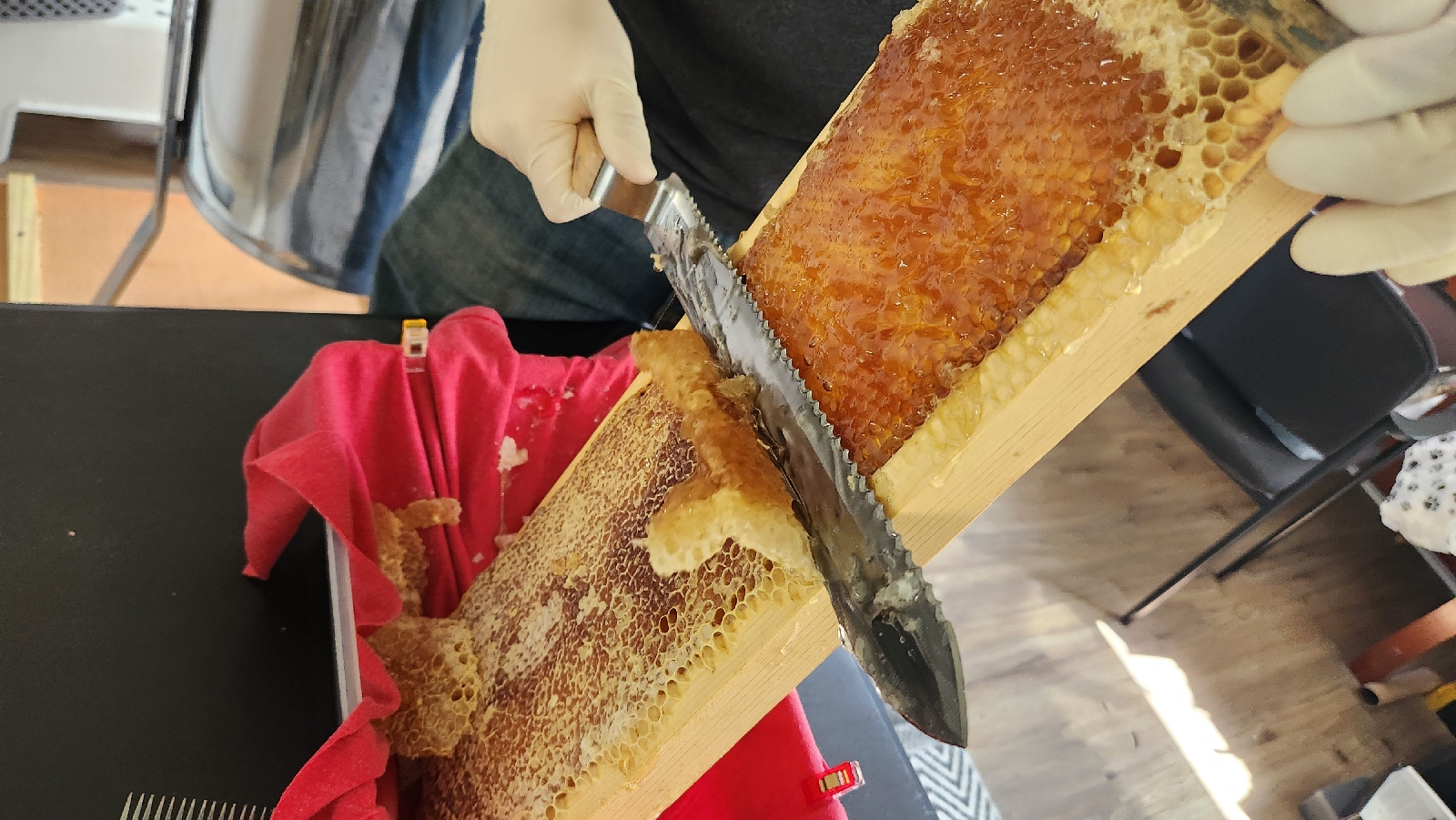
Extracting honey is a messy business that requires removing the honey from the hives (sometimes over the bees' objections), cutting off the wax caps, and spinning the frames in my extractor where centrifugal force does most of the work.
After that, the honey passes through two filters to catch off the bits of leftover wax, pollen and bee bits that may be hanging around in it. Then it goes into the bottles/jars.
This year, we decided to try using recycled Oui yogurt jars for most of the honey. You can buy after-market snap-on lids to go on the jars, which makes them great for storing stuff. 
The lids are also the perfect size for my circular labels. I am a little concerned about the tops coming off in transit, but a set of heat-shrink bands ought to solve that problem.

Tuesday, May 27, 2025

Checking out Kenyan beekeeping

I had the chance to visit Nairobi, Kenya, this week on a work trip, so I thought I would skip the usual tourist traps and see what I could learn about beekeeping in Kenya. It turns out there was a lot to learn! 

For one thing, my driver, Eric, was a beekeeper. He is a member of the Kamba people from eastern Kenya -- a group famous for their beekeeping skills. He keeps 20 hives at his shamba (farm or garden) about 240 km outside Nairobi. In old-school Kenyan fashion, he keeps his bees in hollow logs and scrapes the comb out (he mimicked reaching his arm inside the log) to extract the honey.


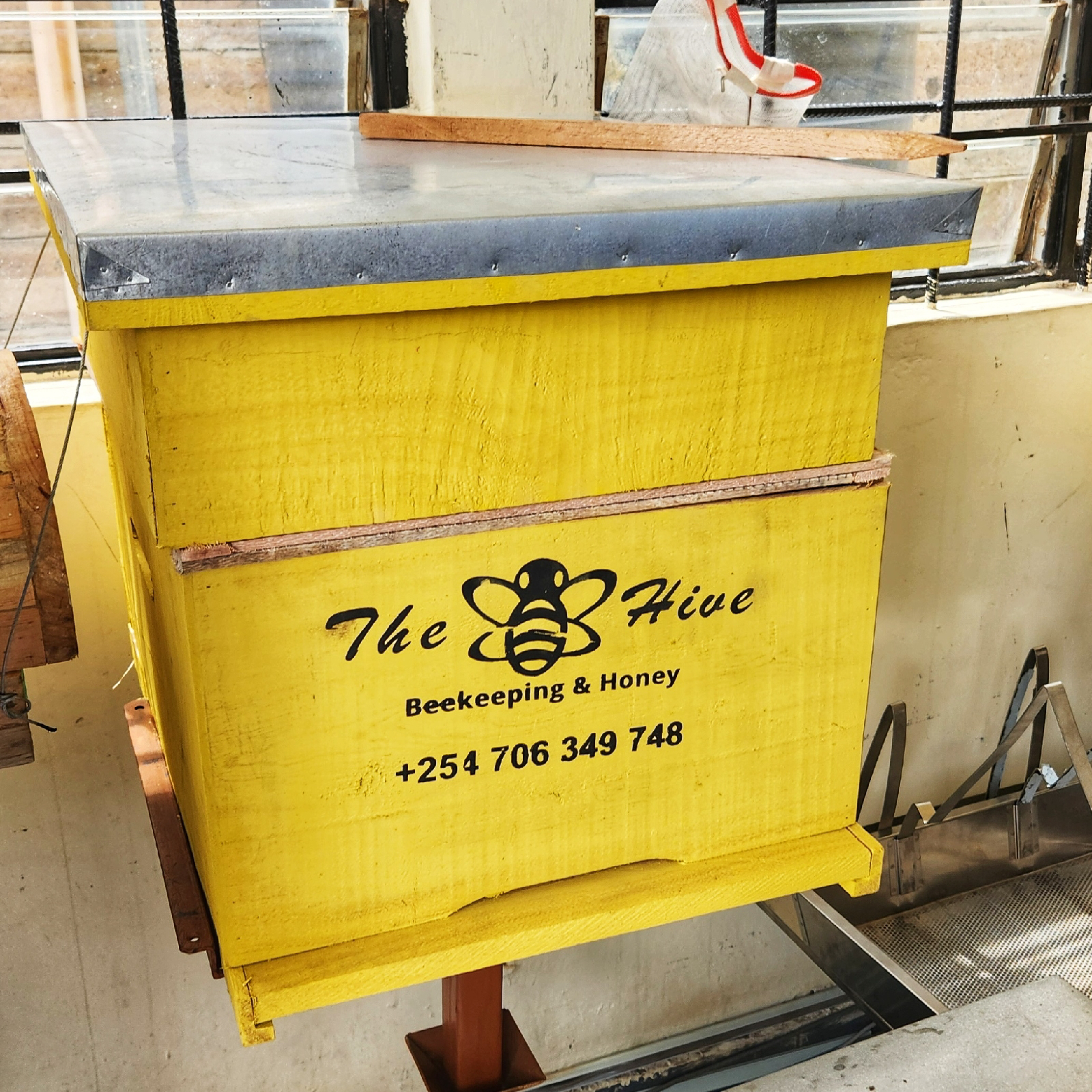
While I didn't get to see Eric's apiary, I did get him to drive me to the local beekeeping supply store. The Hive Group Ltd. runs pollination services all over the country and, as a result, sells honey from all over the country. It also has multiple retail outlets in major cities.

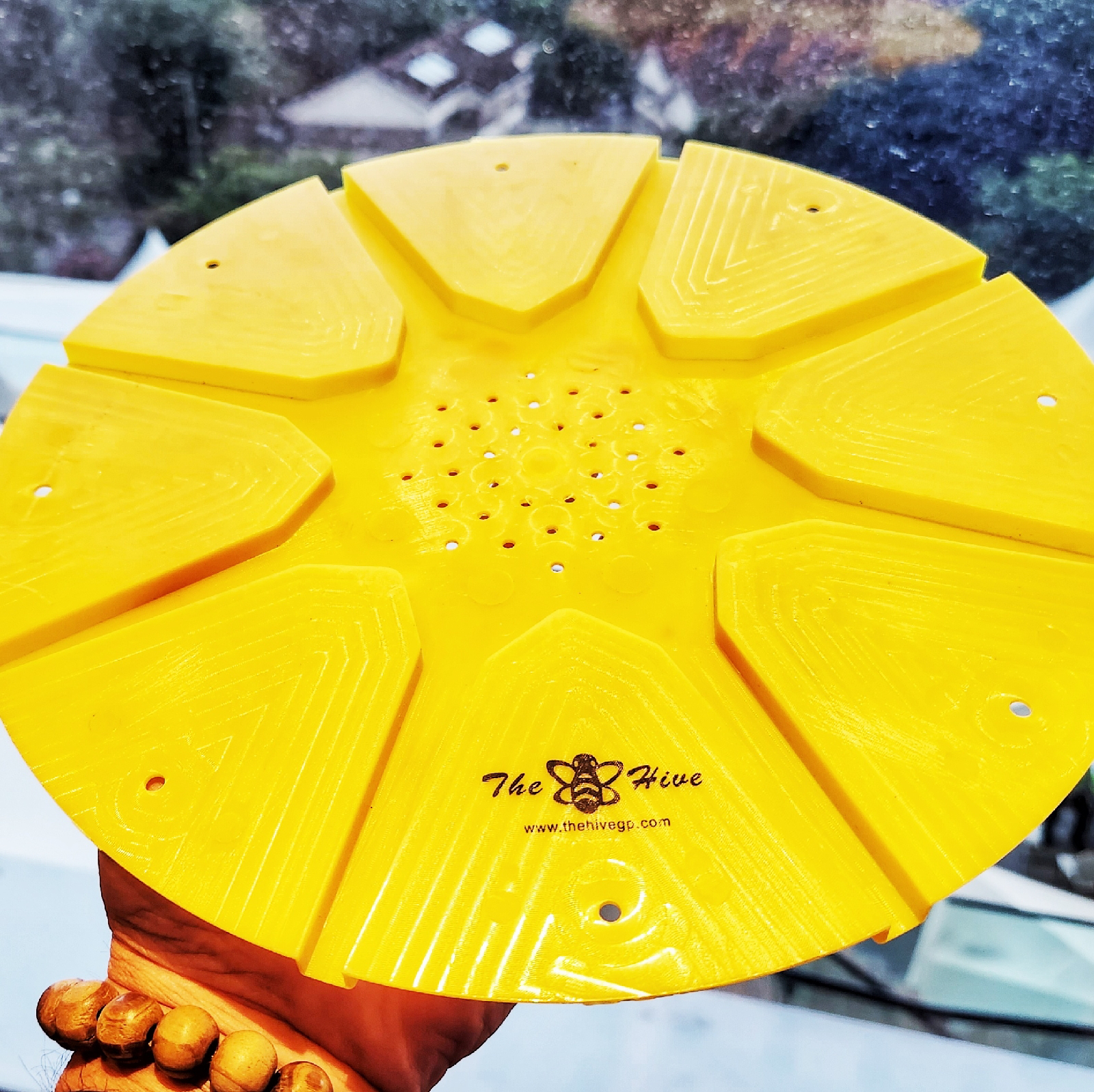
Among my souvenirs from Kenya is this eight-way bee escape -- a tool I had never seen before and immediately wanted to try when I do my first honey extraction in June. Last year, I fought the bees for their honey. This year, we'll outsmart them. While I had never seen such a device, they're apparently popular elsewhere in former British colonies, as this video from New Zealand can attest.


Honey from Kitui County, which is the Kamba heartland, is supposed to be some of the best honey. But it all looked amazing, to be completely honest. Like all beekeepers, the people at The Hive Group were happy to chat about bees (nyuki in Swahili).


Project Manager Richard Kyalo Philip showed Eric and me one of the modern versions of a traditional log hive. This one works like a horizontal hive with round frames instead of rectangular ones.


The curved lid folds back to give you access to the frames, so no more shoving your arm up into a log full of bees and honey comb. (Eric was intrigues.) The set costs about $100.


They also use top-bar hives, which appear to be popular in Kenya, as well as the old Western standard Langstroth hives. The shop was busy with people coming in to buy equipment and get into the business.


A story from May 19 in Kenya's Daily Nation newspaper reports that Kenya's beekeepers are struggling with hive losses and falling far short of the national demand for honey even as the number of beekeepers is growing. Like other country's they may have to start importing honey from elsewhere.


The Hive Group has been around about 10 years and is so connected to Kenya's beekeeping scene that they are Number 001 among the members of the Kenyan Beekeeping Association (which is headquartered just around the corner).


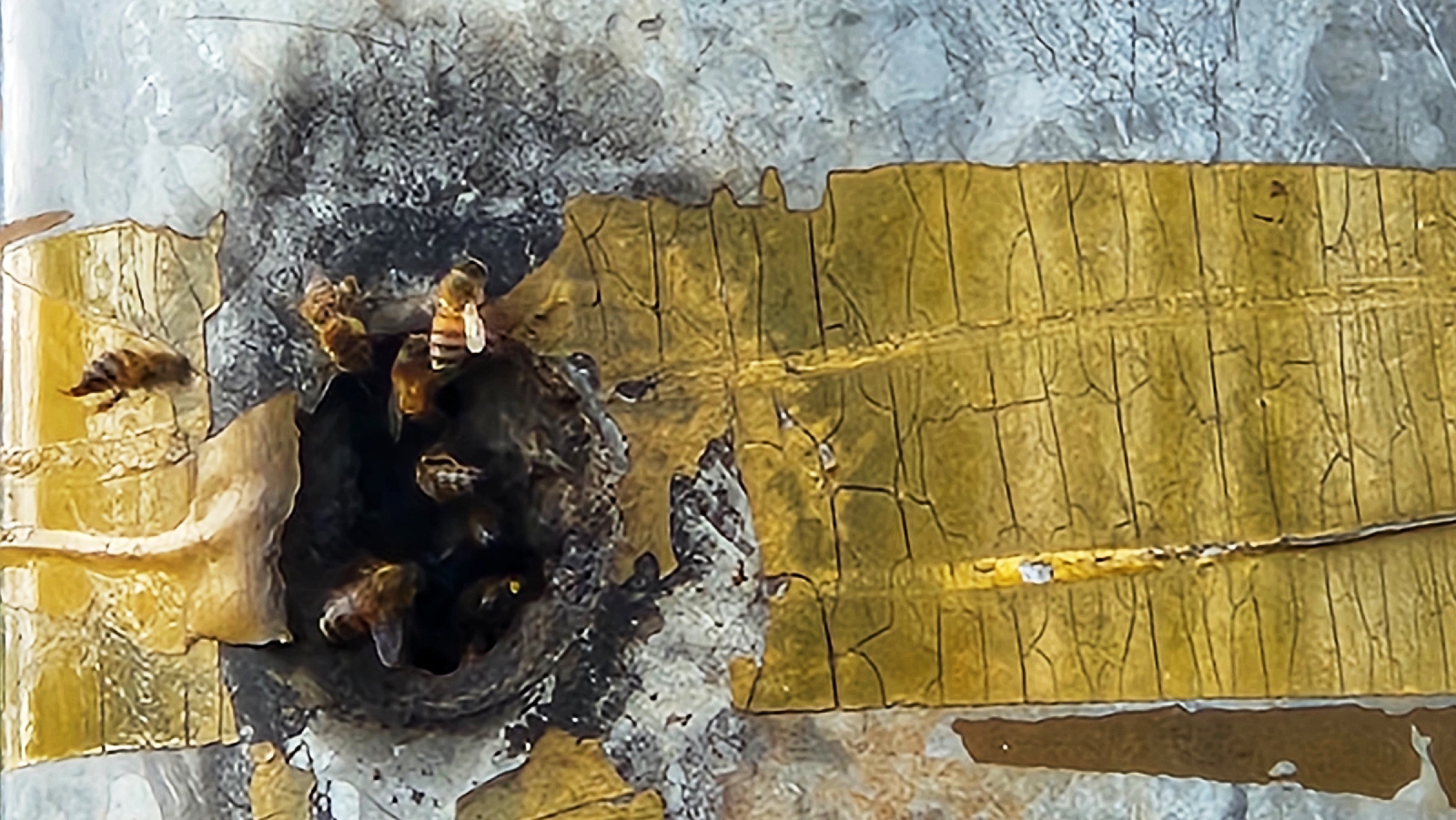
If anybody in Nairobi is looking to expand their apiary by catching/relocating a swarm, I found one for them. On my first day in town, I took a walk through Uhuru Park where I noticed a stream of bees beelining for a hole in a metal light pole.


Come on, Spring!

February 2026 was the Month of Ice this year, so all of our early bloomers (red maples, hellebores) are running weeks behind. Bu...